en
No hay productos en el carrito.


The driving vibration
Changing the driving frequency can bring different resonances into view. The strength of the vibration also affects how clearly a pattern develops.
The science of sound made visible
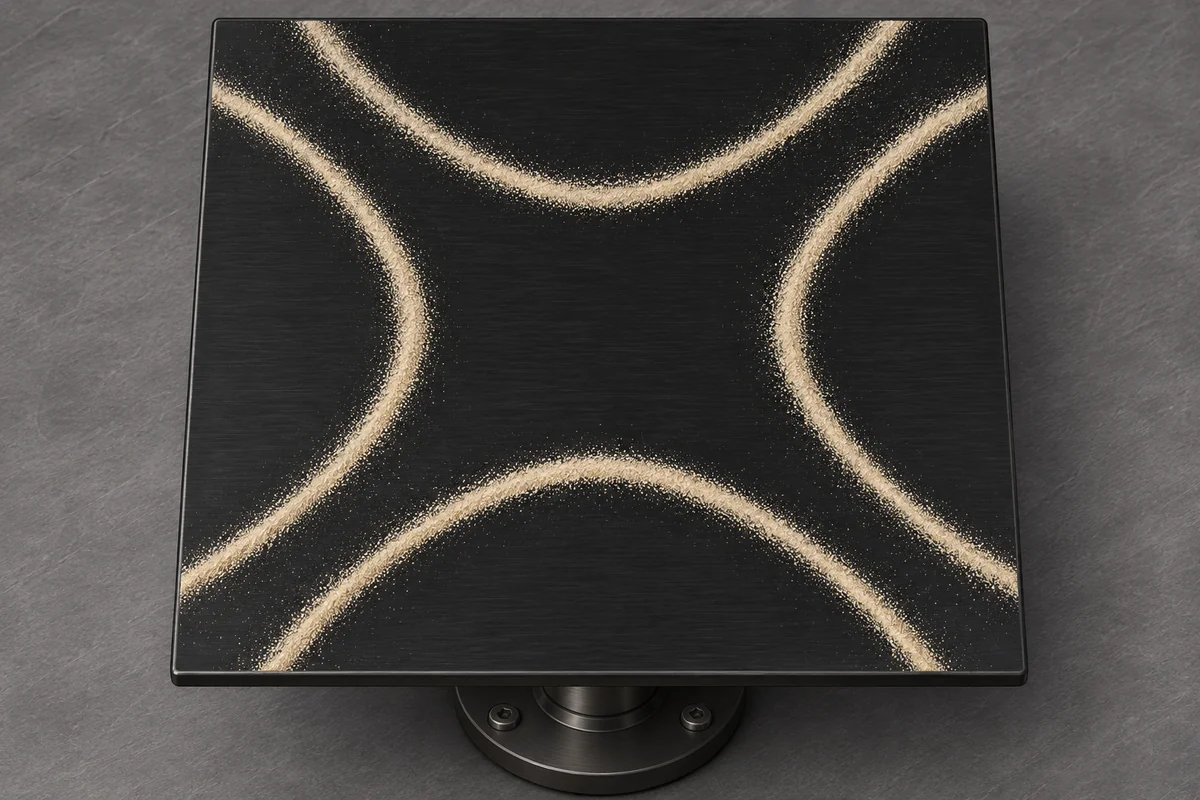
Scatter a little sand across a metal plate. At first, nothing moves. Then a vibration begins. The grains jump, drift and gather into lines. A pattern appears where there was only a dusting of sand.
That moment is the fascination of cymatics: you can watch vibration leave a visible trace. Follow the pattern and a richer story opens up—about sound, the materials it moves through and the attention we bring to listening.
A clear starting point
Cymatics is the exploration of visible patterns and motion created by vibration in materials such as sand, salt and liquids. It makes a physical response easier to observe: a moving plate can arrange grains into lines; a vibrating liquid can develop ripples and surface patterns.
The result is compelling because it gives movement a shape. Something you might otherwise hear as a steady tone becomes a pattern you can follow with your eyes. To understand that pattern, look at the whole experiment: the sound source, the material and the way they interact.
Look closely at the lines
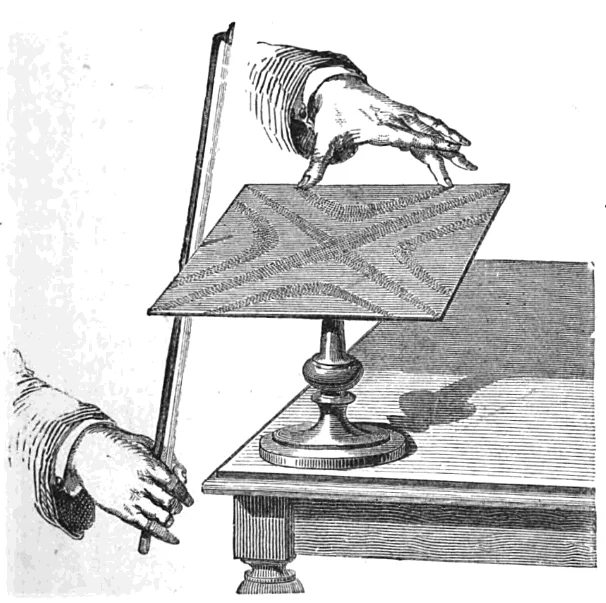
In a classic Chladni experiment, a bow or mechanical driver sets a metal plate vibrating. At a suitable resonance, the plate moves in a distinct mode. Some regions move strongly; others form relatively still boundaries called nodal lines.
Grains are displaced from the more active regions and collect near these lines. The pattern you see maps part of the plate’s vibration. Harvard’s Chladni plate demonstration shows how this works, including how touching the edge changes the mode that is excited.
There is a lovely reversal here: the most visible lines of sand gather where the plate moves least. Once you notice that, the image becomes easier to read. Its quiet places reveal the organization of the movement around them.
From the laboratory to the imagination
The name Chladni figures recalls Ernst Chladni’s work on vibrating plates. A simple arrangement—a plate, grains and a violin bow—made an otherwise difficult motion visible. The historical illustration shows the hands as part of the experiment: where the plate is touched matters.
In the twentieth century, Hans Jenny helped bring the visual exploration of vibration to a wider audience. His book Cymatics, published in 1967, remains a landmark in the subject’s history.
The appeal endures. Watching a pattern emerge offers the pleasure of discovery before you know the vocabulary. Physics gives you a way to investigate what you are seeing; art gives you another reason to keep looking.
Read the setup, not just the number
A frequency is one part of the experiment. The material and its constraints help decide which patterns can appear.
Changing the driving frequency can bring different resonances into view. The strength of the vibration also affects how clearly a pattern develops.
A square plate and a circular plate are different systems. Their geometry, dimensions and material contribute to how they move.
Where the object is held or driven matters. A finger, clamp or central support changes the constraints on its motion.
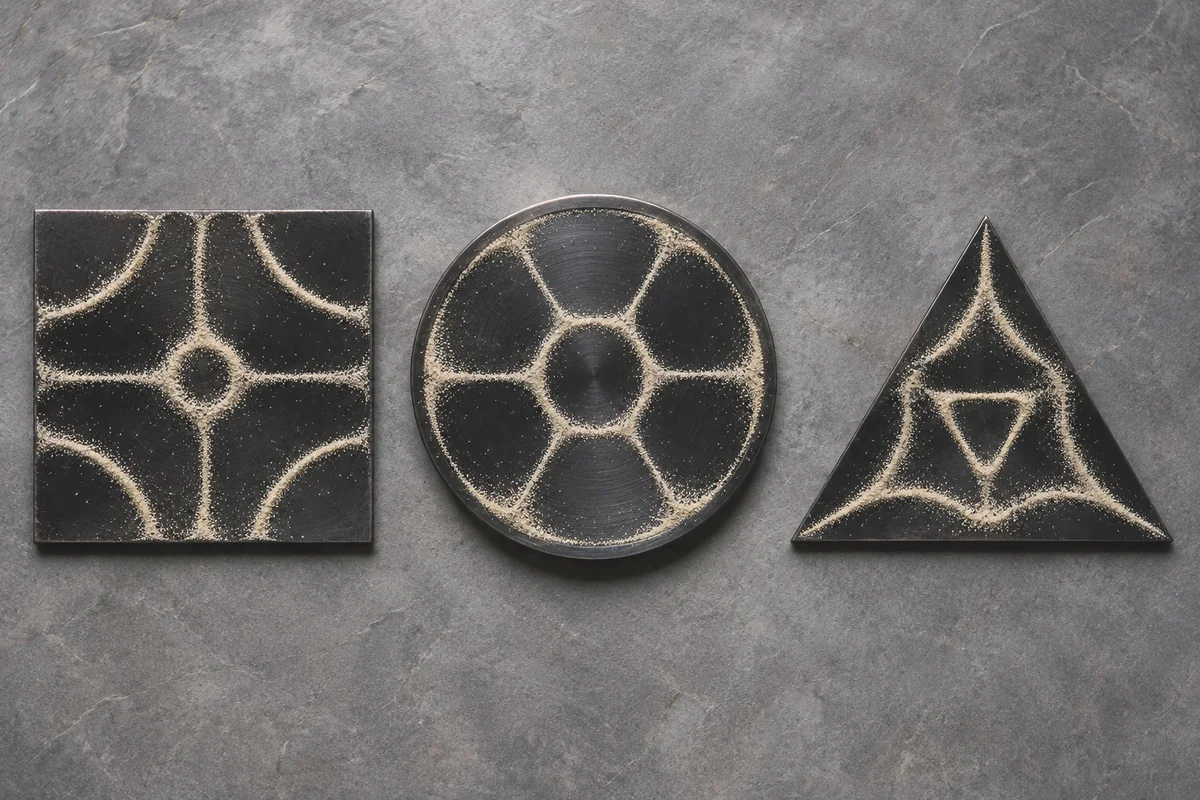
This is why a photograph labeled with a frequency is only meaningful alongside its setup. Repeating the same conditions can reproduce a pattern; moving to another plate can change the result.
For example, Harvard’s larger driven plate has many resonances, each requiring careful tuning. Its published examples belong to that apparatus. They are not a universal chart assigning one image to every frequency.
A surface in motion
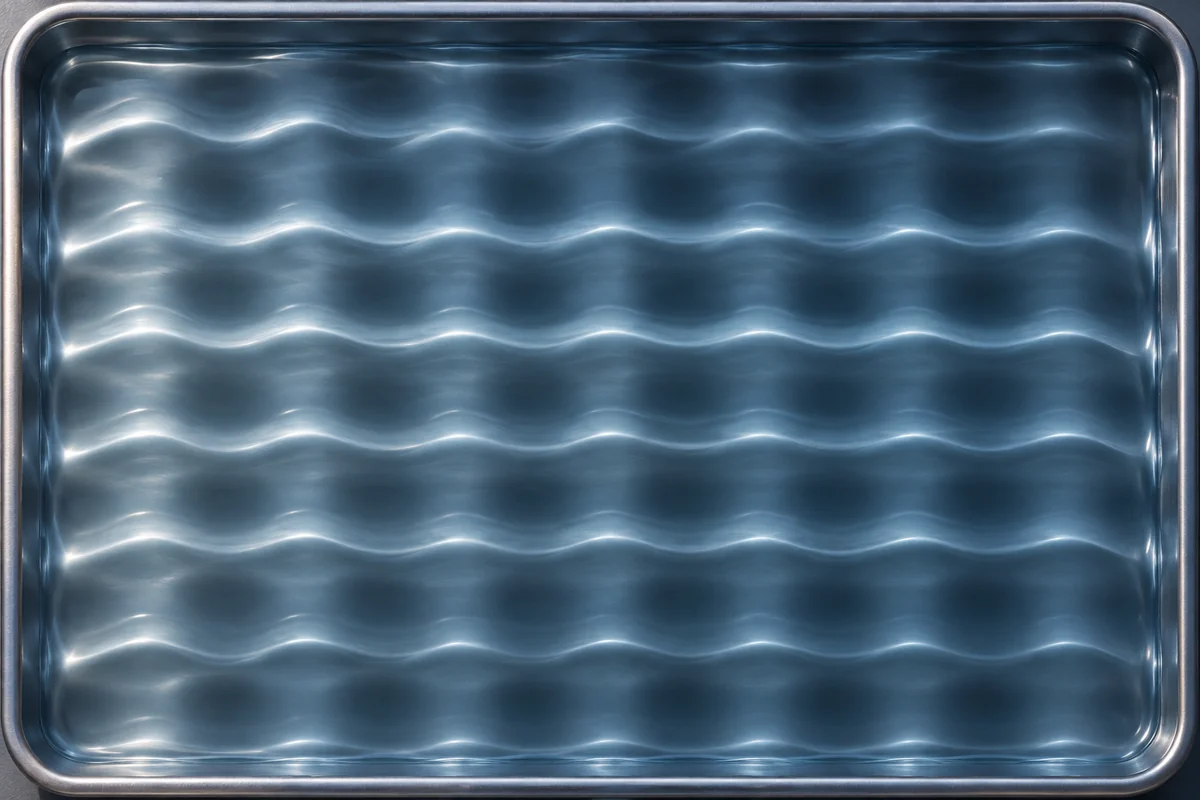
With water, the spectacle changes. Instead of grains gathering on a solid plate, the liquid surface itself moves. Light catches the changing slopes, turning small waves into a visible landscape of bright and dark regions.
Faraday waves are one example: a liquid driven by vertical vibration can develop surface-wave patterns. Michael Faraday investigated vibrating surfaces and liquids in his 1831 experimental paper.
Notice what the photograph actually shows: a pattern at the surface of a particular container of water. The liquid, container and driving conditions are all part of the observation. A bowl of water and a plate of sand offer different windows onto vibration.
Turn fascination into observation
It is easy to focus only on the most intricate shape. Try watching what happens before it settles. The transition—the grains finding their places, a line becoming clearer—often tells you more than the finished image.
Begin with a documented demonstration such as the one linked from Harvard’s experiment page. A phone tone played into the room is not equivalent to a driver coupled to a plate. Clear patterns depend on an appropriate setup, not simply more volume.
This attentive way of looking can become a creative practice in its own right. Sketch a line, notice a symmetry, compare two images. You can enjoy their resemblance to petals or geometric art while staying curious about the experiment that produced them.
Wonder with a clear foundation
A cymatic image is evidence of a physical response in the material being observed. It can help us see vibration modes, compare experimental conditions and appreciate the relationship between movement and form.
Its beauty can also invite symbolism: balance, order, connection, a sense of something larger. Those personal meanings belong to the experience of the viewer. Keeping observation and interpretation clear lets both have their place.
The bridge to the body needs its own explanation. A pattern in a dish does not show that the same pattern forms inside a listener. Hearing, tactile sensation and emotion offer a more useful route into the human experience of sound.
From seeing vibration to listening with attention
After watching sound move a material, you may find yourself listening differently. A sustained tone has texture. A rhythm creates expectation. A familiar musical phrase can draw your attention inward.
Perhaps your day has been full of quick decisions and unfinished thoughts. A deliberate listening pause gives you something simpler to follow: the sound as it unfolds, the contact of your feet with the floor, the natural movement of your breath.
Our Body Resonance of Sound guide follows that human side of the story. It explains the difference between hearing music, physically feeling vibration and being moved emotionally, with practical advice about headphones and speakers.
Mental Waves builds listening environments around rhythm, texture, space and intention. The invitation is to find a sound experience that supports your own moment of calm, presence or inner exploration.
Read Body Resonance of Sound →Choose an intention for your next session
Let curiosity become a listening ritual. These guides introduce two different intentions and explain how to approach each session.
113 Hz
Make room for rhythm, a steadier sense of presence and a quiet return to yourself. Explore the program’s heart-centered approach and practical listening guidance.
Read the 113 Hz guide →157 Hz
Explore the Bioenergetic Harmonizer with an intention of grounding, energetic balance and renewed vitality. Discover the experience and how to make space for it.
Read the 157 Hz guide →Explore further
Questions & answers
Cymatics explores the visible patterns and motion produced by vibration in materials such as sand, salt and liquids. Chladni figures on metal plates are a familiar example: particles reveal the nodal lines of a vibration mode.
A source drives a surface or material into vibration. When a plate responds in a suitable standing-wave mode, grains move away from strongly moving areas and collect near nodal lines. The resulting image depends on the physical setup as well as the driving vibration.
There is no universal pattern attached to a frequency alone. The material, geometry, support and driving conditions all matter. Repeating a carefully controlled setup can reproduce a pattern; changing the setup can change the result.
Chladni figures are patterns made by grains on a vibrating plate. They are named after Ernst Chladni, whose experiments helped make vibration modes visible. The grains typically accumulate along nodal lines, where the plate’s movement is small.
Vibration can create visible ripples and standing-wave patterns at a liquid’s surface. Faraday waves are one example associated with a vertically vibrating liquid. A water-surface pattern and a sand pattern on a metal plate arise in different physical systems.
A phone tone by itself is usually not a reliable way to produce clear Chladni figures. The signal must drive an appropriate plate or membrane effectively. A purpose-built demonstration or a documented experiment is a better starting point than increasing speaker volume.
Cymatic experiments demonstrate physical responses to vibration in specific materials and apparatus. They do not by themselves establish a health benefit from an audio session. Mental Waves uses sound for wellbeing, relaxation and personal exploration; these experiences do not replace medical care.
Read Body Resonance of Sound to explore hearing, tactile vibration and emotional response. Then choose the 113 Hz guide for a heart-centered listening ritual, or the 157 Hz guide for an intention centered on vitality, grounding and inner harmony.
Pillar pages
Follow the full explanatory path: sound as resonance, sound as visible form, body-brain interaction, brainwave states and the technology behind Mental Waves sessions.