en
No hay productos en el carrito.


Hearing
Vibrations move the eardrum and pass through the middle ear into the fluid-filled cochlea. Sensory cells convert that movement into signals the brain interprets as sound.
Sound, sensation & the listening body
A song begins. Before you have found the words for it, your foot is keeping time. A familiar voice brings a shiver. At a concert, a deep bass note seems to land in your chest. Listening can feel like something that happens to your whole body.
What makes those moments so powerful? The answer becomes more interesting when we follow the different paths from sound to sensation. Understanding them gives you a new way to listen: with curiosity, attention and room for your own experience.

The clear answer
Sound is a mechanical vibration. Resonance is the stronger response that can occur when a vibration drives a system near one of its natural frequencies. With the body, the picture is more complex than a single note: hearing, touch and emotion can all contribute to what you feel.
A bass pulse against your chest, a melody that gives you chills and the calm of an unhurried listening session may all be described as “resonance.” Looking at each experience separately helps you understand what sound is doing—and choose the kind of listening you want.
From sound to sensation
These paths can meet in one listening experience. Each tells a different part of the story.
Vibrations move the eardrum and pass through the middle ear into the fluid-filled cochlea. Sensory cells convert that movement into signals the brain interprets as sound.
A vibrating surface or sufficiently strong sound can stimulate your sense of touch. Contact, intensity and frequency help determine whether the movement is perceptible.
A remembered voice, an unexpected harmony or a rising rhythm can feel deeply personal. Chills and emotional intensity do not require a strong vibration against your skin.
The NIDCD’s explanation of hearing follows the first path from ear to brain. The other paths help explain why the same piece can feel different through headphones, in a concert hall or while sitting on a surface that vibrates.
A simple physical principle
Think of a swing. A well-timed series of gentle pushes can build a larger movement. In a vibrating system, a repeated driving force can likewise produce a stronger response near a natural frequency. Friction and other forms of damping limit that response.
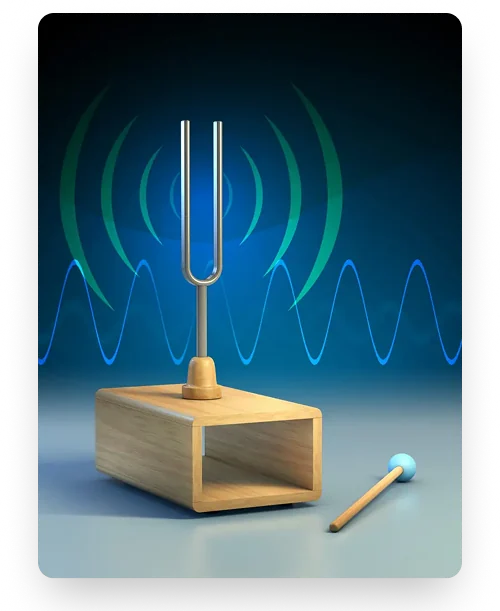
A tuning fork offers another familiar image: its shape and material help determine the note at which it vibrates. Change the system and you change how it responds. This is the physical foundation of forced oscillation and resonance.
Your body contains many interacting structures, fluids and tissues. Applying the same principle to a living person requires knowing what is vibrating, how the vibration arrives and what is actually being measured.
The sensation people recognize
Stand near a bass speaker and a note may seem to have weight. At sufficient levels, sound can create a tactile sensation alongside what you hear. Vibrations may also reach you through the floor or a seat. Distance, the room’s acoustics and your contact with surfaces all change the experience.
This is why a track that feels physical at a concert can seem much lighter through a small speaker at home. The recording is only one part of the experience; the playback system and surroundings matter too.
Let comfort set the volume. A stronger chest sensation is not a better listening session. Keep sound at a comfortable level and take breaks. The WHO’s safe listening guidance explains why both loudness and listening time matter.
No single number describes the whole body in every situation. Different structures have different responses, and posture, support and the way vibration is applied influence measurements. Research using a vibrating seat, for example, addresses a different physical situation from listening to an audio track.
A frequency printed on a session describes an element of its sound design. It does not establish a universal tuning frequency for the heart, the brain or another organ. You can enjoy a frequency-based session without needing that explanation to be true.
Choose your listening environment
A private, detailed soundscape and a room filled with music can both be rewarding. They deliver the experience differently.
| Playback | What reaches you | What to expect |
|---|---|---|
| Ordinary headphones | Sound delivered close to the ears. | Detail, privacy and an immersive listening space. Whole-body mechanical vibration is not their main function. |
| Loudspeakers | Sound through the room; sometimes perceptible vibration in the body or nearby surfaces. | A shared, spatial experience shaped by speaker placement, bass output and the room. |
| Vibrotactile equipment | Mechanical movement through a chair, pad or other contact surface. | Direct tactile stimulation. Findings from this equipment cannot simply be applied to headphone listening. |
In a 2024 study of vibrotactile musical engagement, participants listened through headphones while a chair supplied synchronized vibration. The study reported greater musical engagement with this added tactile input. That result concerns the combined setup; it does not show that an ordinary audio file delivers the same bodily stimulation.
For Mental Waves sessions, follow the listening recommendations in the individual guide. Use headphones when recommended for the intended sound design, and choose a setting in which you can settle comfortably.
Bring the idea into daily life
Perhaps what you want is less dramatic than a wave of sensation. You have spent the day answering messages, moving between tasks and carrying your attention everywhere except here. A listening ritual gives that attention somewhere to rest.
Begin with a comfortable seat and a sound you want to stay with. Let the opening moments arrive without deciding what should happen. Notice the contact of your feet with the floor, the natural movement of your breathing and any change in the way you are holding your shoulders.
Some days the music may feel absorbing; on others, your mind may wander. Neither experience needs to become a score. The useful question is whether this practice gives you a welcome, repeatable moment of rest or attention.
Research summarized by NCCIH suggests that music-based interventions can help some aspects of wellbeing, with results varying by context. Mental Waves listening sessions are offered for wellbeing and personal exploration, not as a substitute for medical care.
Your next listening experience
Choose the intention that speaks to you. Each guide explains the session’s character, intended benefits and practical listening approach.
113 Hz
For moments when you want to step out of mental noise and return to a steadier sense of presence. Explore a listening ritual built around rhythm, heart-centered attention and a quiet inward pause.
Read the 113 Hz guide →157 Hz
For a listening intention centered on renewed vitality and feeling more grounded. Discover the Bioenergetic Harmonizer’s approach to energetic balance, with a clear guide to making the session your own.
Read the 157 Hz guide →These themes describe the intended listening experience. Neither frequency should be understood as a proven universal resonance of the body. Start with curiosity and let your experience remain personal.
Pillar pages
Explore the science of visible vibration, the body and brain, and the sound design behind Mental Waves sessions.
Explore the evidence
These references explain hearing, physical resonance and particular listening or vibration contexts. They do not establish clinical benefits for the 113 Hz or 157 Hz programs.
Questions & answers
In physics, resonance is a stronger response to a driving vibration near a system’s natural frequency. When people describe body resonance of sound, they may also mean feeling bass, becoming aware of bodily sensations or feeling emotionally moved. These experiences can overlap, but they are not the same mechanism.
At sufficient levels, bass from speakers can produce vibrations you feel as well as hear. Your position, the room, the equipment and how vibration reaches your body all affect the sensation. A chest sensation does not identify one universal human resonance frequency. Keep the volume comfortable rather than increasing it to force a physical response.
No single frequency describes the whole body in every situation. Different structures respond differently, and measured responses depend on factors such as posture, support, damping and how vibration is applied. A named audio frequency does not establish a unique tuning frequency for an organ.
Ordinary headphones deliver sound primarily to the ears. Music can still feel immersive and evoke chills or bodily awareness, but headphones do not deliver the same mechanical stimulation as a vibrating chair, contact transducer or powerful loudspeaker.
Here, 113 Hz and 157 Hz name audible sound frequencies used in the programs. They do not describe measured brainwave activity, and hearing a tone does not mean the brain or an organ is vibrating at that frequency.
Music can support relaxation for some listeners, depending on the music, the person and the setting. Research on music-based interventions cannot establish the effects of every individual audio track. Choose a sound you find comfortable and notice your own response.
No. There is no required sensation. You may enjoy the music, notice your breathing or simply appreciate a quiet pause. Tingling, warmth or chills are not a test of effectiveness, and their absence does not mean you are listening incorrectly.
Start with 113 Hz if you are drawn to a heart-centered listening ritual, rhythm and a quiet inward pause. Choose 157 Hz if the themes of vitality, grounding and bioenergetic harmony appeal to you. Both guides explain the intended experience and how to approach the session without promising a particular result.